Wednesday, 26 November 2014

Ghusl

What makes Ghusl Fard?
On five occasions the Ghusl is Fard.

1) Release of sperm with pleasure. If jumped from a higher place or lifted heavier stuff which caused sperm to discharge, Ghusl is not wajib but will break the Wazoo.
2) Wet dream with semen discharge.
3) When ever the tip of man's private part (mushroom) enters woman's private part.(Even with intention or without intention)
4) Haiz (monthly period for women)
5) Nafaas ( The release of blood after a woman gives birth)

Fards in Ghusl.

There are three fards in Ghusl.

1) To wash mouth with water as it should reach all the parts internally. From lips to the base of throat. If not fasting gargle. If there is any thing stuck in between teeth such as a piece of meat, paan, beetle nut; it should be removed before Ghusl or the Ghusl will not be completed.
2) To wash inside of nose with water. Water should be pulled hard enough all the way to the soft part of the base of nose. If there is any dry phlegm (hard ratoobat) inside the nose it must be cleaned and if a the nose is pierced water should be forced into the hole or the Ghusl will not be completed.
3) To wash the body once from head till the bottom of feet. The water must pour over body. Every strand (hair) and skin of the body must get wet. Even if a single strand or a small portion of skin is not washed the Ghusl will not be completed.

Sunnats in Ghusl.

1) To perform a ghusl in the sunnat, we must first wash both of our hands and privates parts even if they may be clean, then if there any najasat (impurity) on our body, we must wash it away.
2) We must perform a complete ablution.
3) While washing our face we must intend to perform a ghusl.
4) If water will not accumulate under our feet; we must wash our feet, too.
5) We must pour water on our entire body three times. When you do this, we must pour it on our head three times first, then on our right shoulder three times and then on the left shoulder three times. Each time the part on which we pour water must become completely wet. We must also rub it gently, during the first pouring.
6) In a ghusl, it is permissible to pour the water on the limb so as to make it flow onto another limb, which, in this case, will be cleaned, too. For in a ghusl the whole body is counted as a one limb. If in performing an ablution the water poured on one limb moistens another limb, the second limb will not be considered to have been washed.
7) When a ghusl is completed it is makruh (things which our Prophet did not like) to perform an ablution. But it will become necessary to perform an ablution again if it is broken while making a ghusl.

Six Kalimas in English Tajveed

1) Kalma Tayyab: Laa ilaaha illal Lahoo Mohammadur Rasool Ullah

2) Kalma Shaadat: Ashahado An Laa ilaaha illal Laho Wahdahoo Laa Shareeka Lahoo Wa Ash Hado Anna Mohammadan Abdo Hoo Wa Rasoolohoo.

3) Kalma Tamjeed: Subhanallahe Wal Hamdulillahe Wa Laa ilaha illal Laho Wallahooakbar. Wala Haola Wala Quwwata illa billahil AliYil Azeem.

4) Kalma Tauheed: Laa ilaha illal Lahoo Wahdahoo Laa Shareekalahoo Lahul Mulko Walahul Hamdo Yuhee Wa Yumeeto Wa Hoa Haiy Yul La Yamooto Abadan Abada Zul Jalali Wal ikraam Beyadihil Khair. Wa hoa Ala Kulli Shai In Qadeer.

5) Kalma Astaghfar: Astaghfirullah Rabbi Min Kullay Zambin Aznabtuho Amadan Ao Khat An Sirran Ao Alaniatan Wa Atoobo ilaihe Minaz Zambil Lazee Aalamo Wa Minaz Zambil Lazee La Aalamo innaka Anta Allamul Ghuyoobi Wa Sattaarul Oyobi Wa Ghaffaruz Zunoobi Wala Haola Wala Quwwata illa billahil AliYil Azeem.

6) Kalma Radde Kufr: Allah Humma inni Aaoozubika Min An Oshrika Beka Shai Aown Wa Anaa Aalamo Behi Wa Astaghfiroka Lima laa Aalamo Behi Tubtu Anho Wa Tabarrato Minal Kufri Washshirki Wal Kizbi Wal Jheebati Wal Bidaati Wan Nameemati Wal Fawahishi Wal Bohtani Wal Maasi Kulliha Wa Aslamtoo Wa Aamantoo Wa Aqoolo Laa ilaaha illal Lahoo Mohammadur Rasool Ullah.

First Kalma


Meaning:

                                             The word of Purity (Tayyabah) .

(There is) none worthy of worship except Allah. Muhammad is Messenger of ALLAH. 


Declare the Oneness of Allah,
La ilaha illallah,
Allah is one and can’t be three,
The truth is simple as can be.
He’s the source of everything,
And doesn’t need a single thing,
He wasn’t born and will not die,
And that is surely not a lie. 


Muhammad-ur-Rasulullah,
The final Prophet of Allah,
Peace and blessings on him too,
Who came to show us what to do.
Allah chose him for mankind,
No one greater will we find,
And his Sunnah is our guide,
By his ways we should abide. 


Those who believe in Allah now,
Must accept this simple vow,
La ilaha illal lah,
Muhammad-ur-Rasulullah,


This shahadah is a sacred creed,
Live by it and you'll succeed,
And be a witness to the truth,
Though you be a child or youth.

Tuesday, 25 November 2014

How To Perform Tayammum

1 Spot a clean place. This can be anything natural like rock, sand or grass.


2 Recite the following:

Bismillaah hirahmaan nirrahiim "In the name of Allah, the most Gracious, the most Compassionate"


3 Make niyyah, or the intention to perform tayammum.


4 Place hands on the ground.


5 Lift hands and ensure that there is no dust on the palm surface by rubbing hands together.


6 Rub face with hands The face encompasses the right ear to the left,


7 Repeat steps 4 and 5.


8
Rub your arms. Use your left hand to rub your right arm from the fingers to the elbow, and back along the inner arm to the hand. Do the same with the other arm using the right hand.


How to Perform Wudu

Wudu, or ablution, is both a traditional ritual and a practical means by which Muslims seek to maintain good physical and spiritual hygiene. Traditionally, Wudu refers to the mental preparation and physical cleanliness of Muslims for the Salat (prayer/Tholugai), one of the Five Pillars of Islam.


  1. 1
    Make niyyah (Intention) to perform washing. Niyyah is the Islamic concept of performing an act for the sake of Allah. To truly perform Wudu, you should center yourself and quiet your thoughts, focusing seriously on what you are doing.
    • Niyyah doesn't necessarily involve saying anything out loud, but focusing on the phrase "Bismillah" (In the name of Allah) is a good way to accomplish the centering necessary. Say it out loud or silently to yourself, whichever makes you comfortable.

  2. 2
    Wash your hands. Use your left hand to wash your right hand. Do this three times. After that, use your right hand to wash your left hand three times. Make sure to wash in between your fingers and all the way up to your wrists.[1]

  3. 3
    Take water into your mouth. Use your right hand to cup water into your mouth three times. Swish it around in your cheeks and the back of your throat. Do this thoroughly to get all the remaining food in your mouth out.

  4. 4
    Inhale water into your nose. Use your right hand to cup water and inhale it into your nose three times. You can use your left hand to close one nostril and blow out if you need to. Snort sharply and abruptly without taking too much water into your nose and choking yourself. If you cannot inhale water into your nose, you can wet your fingers and put water on the lower part of your nostril.

  5. 5
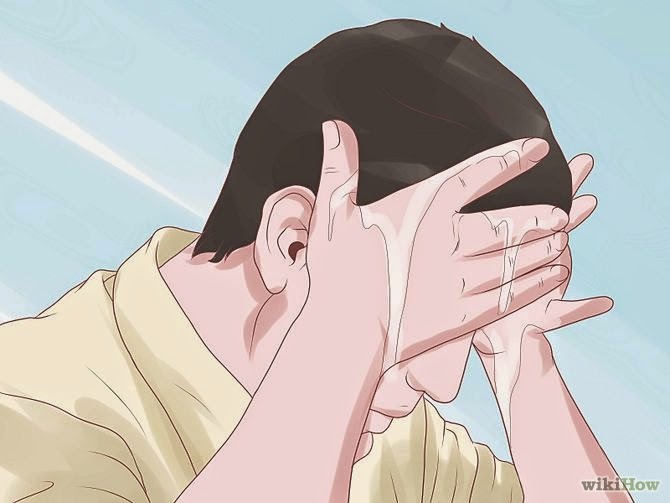
    Wash your face. Wash your face three times by spreading your hands from your right ear to the left, and from the edge of the hair to the chin.

  6. 6
    Wash your lower arms from wrists to elbows, leaving no part dry. From your wrist to your elbow, wash your right arm with your left hand three times and then wash your left arm with your right hand three times.

  7. 7
    Clean your head. Using your wet hands, gently wipe your forehead from the eyebrow to the hairline. Also wipe down your hair, the back of your neck, and your temples. Do this one time.

  8. 8
    Wipe your ears inside and out. With the same water, use your finger to clean all the crevices of your ear. Use your thumb to clean behind your ears from the bottom upward. This is also done one time.

  9. 9
    Wash each of your feet. Clean up to the the ankles and be sure water goes between the toes. Use your pinky finger and go through each toe to eliminate anything between. Start with your right foot and scrub each foot three times.

  10. 10
    While pointing the right index finger to the sky, recite a brief prayer of witness. Generally, the prayer is as follows: "Ash-hadu anlaa ilaaha illALLAHu wahdahuu laa shariikalahu, wa ash-hadu anna Muhammadan 'abduhuu wa rasuuluhu."
    • In English, this is translated as "I bear witness that there is no deity save Allah alone; He is One; He has no partner and I bear witness that (Hadrat) Muhammad (sallallahu ala Muhammadu sallallahu alaihu Wasallam) is His (chosen) servant and (true) Messenger."

  11. 11
    Repeat Wudu after it has been nullified. Actions that nullify Wudu include natural discharges, including urination, defecation, excessive bleeding, and gas. Deep sleep also nullifies Wudu.
    • After intercourse, re-performing Wudu alone is not enough to be able to perform Salat. There is another form of purification that must be performed known as Ghusul.

About Women in Islam

In Islam, woman has a high status which no past nation ever achieved. For instance in Christianity the women were regarded as someone who did not even have a soul. Islam does justice to both men and women.    

 Allah says:
"Whoever works righteousness - whether male or female - while he (or she) is a true believer (of Islamic Monotheism) verily, to him We will give a good life (in this world with respect, contentment and lawful provision), and We shall pay them certainly a reward in proportion to the best of what they used to do (i.e. Paradise in the Hereafter)" [al-Nahl 16:97]
And whoever does righteous good deeds, male or female, and is a (true) believer [in the Oneness of Allaah (Muslim)], such will enter Paradise and not the least injustice, even to the size of a Naqeera (speck on the back of a date stone), will be done to them�
[al-Nisa 4:124]
The above verses thus shows that paradise is  for both   men nor and women. Its also shows that Paradise is not for any man or any women but it is for a women  and men  who is are true Muslims and are righteous.
In Islam there is no competition between the two sexes unlike the uncivilized nations who are infested with women trying to compete with men and loosing their femininity and themselves in the competition.
However, in the Islamic way of life , the civilized way of life, men and women are both helpers of each other. As we can see from the following verse in which Allah, Lord of the worlds, says:-
�The believers, men and women, are Awliya� (helpers, supporters, friends, protectors) of one another�
[al-Tawbah 9:71]

How to Convert to Islam and Become a Muslim

It is easy to become a Muslim. To become a Muslim one must simply pronounce the Shahaadatayn (Declaration of Faith) with sincerity and conviction.

The Shahadah is the following :
" Ash-hadu an laa ilaaha illaallaah, wa ash-hadu anna Muhammadan-ar-rasool ullaah " (In Arabic)

"I bear witness that there is no God  worthy to be worshiped but Allah, and I bear witness that Muhammad is the  Messenger of Allah." (Translation IN English)
Pronouncing the testimony of faith is sufficient to make one a convert to Muslim. There are however, seven conditions that must be observed before it can effectively make one a Muslim. Let us look at what these conditions are before we describe the procedure for taking the shahadah .
They are  as follows:


1  Knowledge (Al-ilm)

Knowledge (al-ilm) of its meaning, what it negates and affirms. If a person says it without knowing its meaning, nor what its requirements are, then he will not benefit by it, because he has not believed in what it requires. Rather, he is like someone who speaks in a language that he does not understand.

The Shahadah  is the dividing line between unbelief (kufr) and Islam. It is also called the kalimah (word). Whoever says it with truthfulness will enter the Gardens of Paradise 


It is a kalimah that Allah Himself has testified to, as have the angels and those who possess knowledge from amongst His creation. Allah the Most High said:


"Allah bears witness that none has the right to be worshiped except Him; as do the angels and those who possess knowledge. He maintains His creation upon justice. None has the right to be worshiped except Him, the All-Mighty, All-Wise."

[Soorah Aal-Imraan 3:18]

 It is a concise declaration that contains few letters; light upon the tongue, yet heavy in the scales.


 Prophet sallallahu alaihi wasallam, who said: "A person from my Ummah (nation) will be summoned in front of everyone on the Day of Resurrection. Ninety-nine scrolls will be unfurled for him, each scroll extending as far as the eye can see. Then it will be said: Do you deny any of this [i.e. your bad deeds]? So the man will reply: No, 0 Lord. Then it will be said: Do you have any excuse or any good deed? The man, in a state of terror, will answer: No. It will then be said: Rather, you do have some good deeds and no injustice will befall you this Day. So a parchment will be taken out for him, upon which there will be the testification of laa ilaaha illallaah and the testification that Muhammad is the Slave and Messenger of Allah. The man will say: 0h Lord, what is this parchment in comparison to those scrolls! It will be said to him: No injustice shall befall you. The scrolls will then be placed in one of the scales and the parchment in the other; the scrolls will be light in weight, whereas the parchment will be heavy." ( Reported by at-Tirmidhee (no.2641), from Abdullaah ibn Amr radhiyallahu anhu. It was declared to be saheeh by Shaykh al-Albaanee in as-Saheehah (no.135).


The first part of the Shahadah is laa ilaaha illallaah (none has the right to be worshiped except Allah) and the first part of the Shahadah has two pillars: 
The first pillar is the pillar of negation (nafee), whilst the second is the pillar of affirmation (ithbaat).
What is meant by negation is to negate divinity and worship (ilaahiyyah) for anything except Allah, the Most High.
 What is meant by affirmation is to affirm divinity and that worship is  only for Allah the Most Perfect; for it is He alone that is the true Deity. So whatever else is taken by the unbelievers as deities to be worshiped are in fact all false and futile: That is because Allah is the true Deity to be worshiped, and whatever else they invoke besides Him is vain falsehood.
[Soorah al-Hajj 22:62]
Imam Ibn al-Qayyim said: The significance of laa ilaaha illallaah in affirming divinity and worship for only Allah is far greater than just saying that Allah is an ilaah (God). This is because the saying that Allah is an ilaah (God)does not negate divinity and worship to other than Allah. This is different to the saying: laa ilaaha illallaah; which obligates restricting divinity and worship to only Allah.  


All the messengers of Allah told their people none has the right to be worshiped except  Allah

Allah said: "We did not send any Messenger before you, except that We revealed to him that none has the right to be worshiped except Me; so worship Me."
[Soorah al-Anbiyaa 21:25]
Allah the Exalted also said: "He sends down the angels with the revelation of His commands to whosoever of His slaves that He wills, saying: Warn mankind that none has the right to be worshiped except Me. So fear Me [by keeping away from sin and disobedience]."
[Soorah an-Nahl 16:2]
It is a concise declaration that contains few letters; light upon the tongue, yet heavy in the scales.
 Allah's Messenger Peace be upon him said: "Moses said: 0h my Lord! Teach me something by which I can remember You and supplicate to You. Allah said: 0h Moses! say laa ilaaha ilallaah. Moses said: 0h my Lord! All Your slaves say this. Allah said: 0h Moses! If the seven heavens and all that they contain, other than Me, and the seven earths were placed in one scale, and laa ilaaha ilallaah were put in the other, then laa ilaaha illallaah would outweigh them all." (Reported by Ibn Hibbaan in his Saheeh (no.2324) and al-Haakim in al-Mustadrak (1/528). 


Ibn Uyaynah, (radhiyallahu anhu) said: "Allah has not bestowed any favour upon His slaves greater than the favour of them realizing laa ilaaha ilallaah. Indeed laa ilaaha illallaah is to the people of Paradise, what cool water is to the people of this world." ( Related by Ibn Rajab in Kalimatul-Ikhlaas (p.53)


The second part of the "Shahadah" i.e. "Wa ash-hadu anna Muhammadan-ar-rasool ullaah  " means that the Prophet Muhammad  is the servant and chosen messenger of Allah. No one should be in any doubt about this matter.
 In fact, the Muslim has to obey the commands of the Prophet , to believe in what he has said, to follow his Teachings, to avoid what he has forbidden, and to worship A11ah alone according to the message revealed to him.
Allah says:
Indeed Allah conferred a great favour on the believers when He sent among them a Messenger (Muhammad ) from among themselves, reciting unto them His Verses (the Quran), and purifying them (from sins by their following him), and instructing them (in) the Book (the Quran) and Al­Hikmah [the wisdom and the Sunnah of the Prophet  i.e. Prophet's legal ways, statements, acts of worship, etc.], while before that they had been in manifest error.(Quran 3:164)
Allah says to His Messenger:
Say (O Muhammad  to mankind): "If you (really) love Allah then follow me , Allah will love you and forgive you of your sins. And Allah is Oft-Forgiving, Most Merciful." ( Quran 3:31)
Allah again tells his Messenger
Say (O Muhammad): "Obey Allah and the Messenger (Muhammad )." But if they turn away, then Allah does not like the disbeliever's (Quran 3:32)
Allah says:
But no, by your Lord, they can have no Faith, until they make you (O Muhammad ) judge in all disputes between them, and find in themselves no resistance against your decisions, and accept (them) with full submission.(Quran 4:65)
What is the meaning of worship? It simply means rendering sincere service; showing reverence for Allah. In a deeper shade of meaning, it implies total submission and complete obedience to Allah's Commandments both in utterances and actions, whether explicit or implicit and in private or public.